Causes of Wear in Hot Forging Press Dies
Thermal fatigue, abrasive wear and the methods that extend die life.
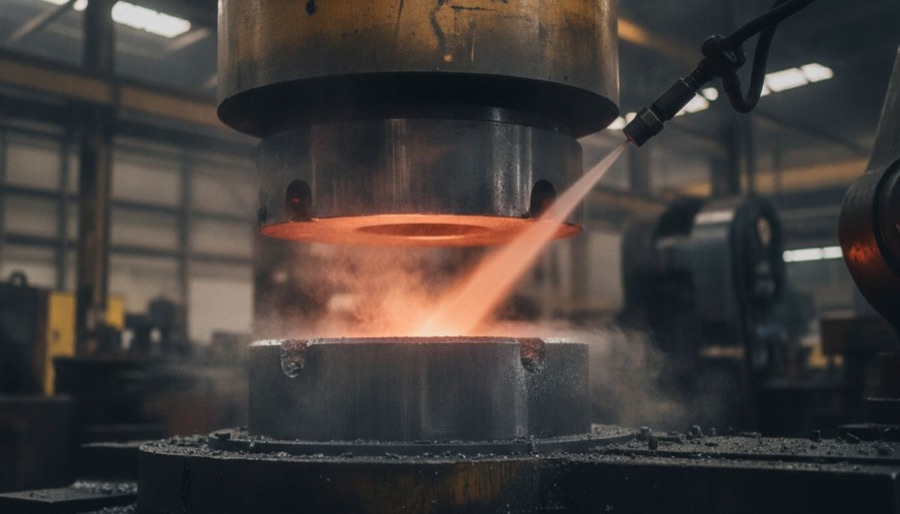
Hot forging dies work under high temperature and high pressure. As they wear, part tolerances drift, flash increases, presses stop for die changes and the cost per part goes up. Understanding why dies wear is the first step to making them last longer.
Why die wear matters
Every change on the die surface is copied onto the forged part. A worn die also resists metal flow, so the press needs more tonnage, and eventually parts go to scrap. For some parts, cold forging is a better alternative, but where hot forging is needed, die life decides the economics.
The four wear mechanisms
- Abrasive wear: hard oxide scale on the billet scrapes the die surface.
- Adhesive wear: micro-welding between the hot metal and the die tears material away.
- Plastic deformation: loads above the yield strength of the die steel deform edges and radii.
- Thermal fatigue (heat checking): repeated heating and cooling cracks the surface.
These mechanisms feed each other. Heat checks give scale a place to catch, and abrasion opens the way for cracks to grow.
Thermal fatigue and mechanical stress
Each stroke heats the die surface quickly, and lubrication and spray cool it again. The surface swings between compressive and tensile stress, fine cracks appear and grow, and in the end pieces can spall or the die can break. Preheating the die and keeping its working temperature steady reduce this cycle.
Die steel and heat treatment
Hot-work tool steels such as H13 are the usual choice, but the steel is only as good as its heat treatment. Under-tempered dies are brittle; dies left too soft wear fast. Machining quality and a well-polished surface also extend life.
Lubrication, cooling and process settings
The lubricant reduces friction and heat transfer. Too little causes sticking; uneven cooling causes cracks. The billet furnace temperature matters too: too hot means more scale and harder impacts on the die.
Surface engineering and maintenance
Nitriding and PVD or CVD coatings harden the die surface against abrasion and adhesion. A simple checklist on every shift helps:
- Preheat the die before production
- Remove scale from billets and die
- Check dimensions and look for cracks
- Polish and stress-relieve dies at set intervals
Frequently asked questions
How do I recognise heat checking?
A fine network of cracks on the die surface, usually first on the hottest areas and edges, which then shows on the parts.
What happens if the die is not preheated?
The first strokes put a cold die under a severe thermal shock, which starts cracks early and can break the die.
What reduces abrasive wear the most?
Removing scale from the billet, hardening the die surface and using a lubricant with the right viscosity.
Better die life, steadier production
Die life depends on the whole chain: steel selection, hardening, the balance of lubrication and cooling, and preventive maintenance. Good die design, with generous radii and even sections, and forging simulation before production help just as much.